ID & the law
Dog ID tag law in the UK: what you need to know
In the UK, dogs in public must wear a collar tag with the owner's name and address. Here's what the Control of Dogs Order 1992 requires, the exemptions, and the penalties.

- Dogs in a public place must wear a collar with the owner's name and address on it or on an attached tag.
- A phone number isn't legally required, but it's strongly recommended.
- This is separate from microchipping, which is also required by law.
- A QR tag like Riley Tag doesn't replace the engraved tag; wear both.
What the law says
Under the Control of Dogs Order 1992, which applies in England, Scotland and Wales, any dog on a highway or in a place of public resort must wear a collar with the name and address of the owner inscribed on it, or on a plate or badge attached to it.
In practice that means a dog tag showing:
- Your name (your surname is usually enough), and
- Your address, including your postcode. Many owners use their house number or name and postcode.
Is a phone number required?
No, but it's sensible. A finder is far more likely to call or text than to knock on your door, especially at night. Many owners include a mobile number.
Exemptions
The Order exempts some working dogs, including dogs used for sporting purposes and packs of hounds, dogs used for the capture or destruction of vermin, dogs used for driving or tending cattle or sheep, guide dogs and other assistance dogs, dogs used in emergency rescue work, and dogs used by the police, the armed forces or HM Revenue & Customs.
What about harnesses?
The Order refers to a collar. If your dog walks on a harness, the safest approach is for them to wear a collar with an ID tag as well, or to check with your local authority.
Penalties
Failing to comply is a criminal offence, and an owner can be fined up to £5,000. In practice, the bigger cost is a lost dog that's harder to get home.
Microchipping is separate
All dogs in England, Scotland and Wales must also be microchipped and registered on a compliant database, and owners must keep their details up to date. A microchip is permanent but invisible; a tag is visible but can come off. The law requires both. Read our microchipping guide.
Where Riley Tag fits
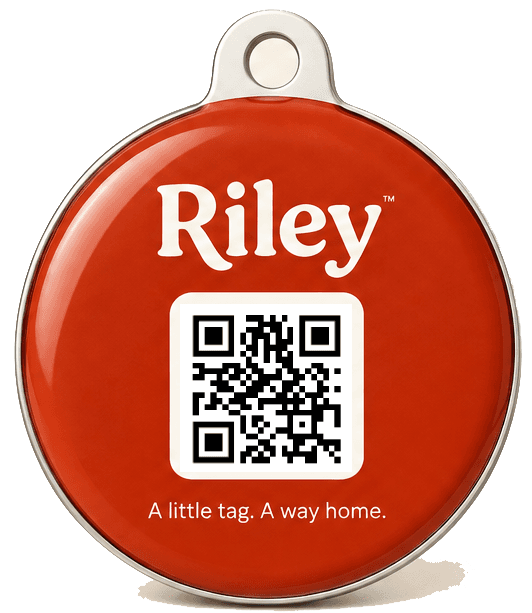
Riley Tag shows a QR code, not your address, so it doesn't satisfy the Control of Dogs Order on its own. Keep your engraved tag. Riley Tag adds what engraving can't: a private way for finders to message you, care notes, lost mode, and details you can update in seconds. Compare Riley Tag with an engraved tag.
Frequently asked questions
Does my dog need to wear a tag in the garden?
The Order applies to dogs on a highway or in a place of public resort, so not in your private garden. But dogs do escape from gardens, so many owners leave the collar and tag on.
Should I put my dog's name on the tag?
It's not required. Some owners leave it off, worried that a stranger could use the name to call the dog. It's a personal choice.
This guide is general information for UK pet owners and isn’t legal or veterinary advice. Laws differ across the UK nations and can change. For medical concerns, contact your vet.